
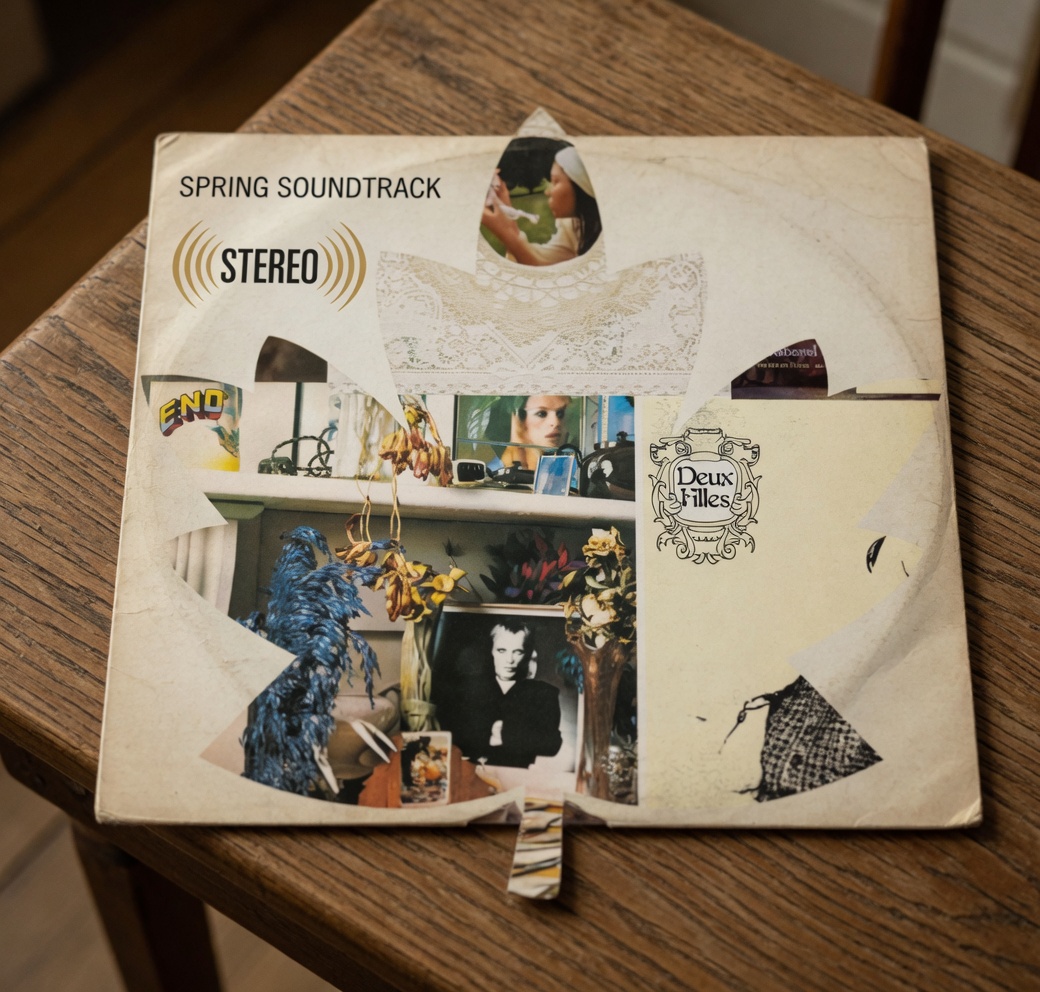
Each year, as winter’s grip loosens and spring wonders whether to begin, it’s starting to feel as though the world is slowly coming back to itself, once again. As British tradition dictates, one single sighting of the sun and there is music, suddenly, everywhere. You can hear it when the trees begin to bloom outside the kitchen window. In the beer gardens overlooking the river filling up on a Wednesday afternoon. When you leave a coat behind for the first time and step out, just cool enough, into the first sight of a new season. To me, the following albums are examples of an attempt to bottle up that feeling into their run-times, in hopes that the warm weather might stick around this time.
Silence and Wisdom — Deux Filles (1982)

In the heights of southwestern France, where the long shadows of the Pyrenees slope down towards the town of Lourdes, two teenage girls meet in search of its holy waters. It’s on this unlikely pilgrimage that Gemini Forque and Claudine Coule form a friendship, drawn to one another by both of their families’ uncanny brushes with death and battles with terminal illness. They resolve to work through their grief together, culminating in their 1982 album, Silence and Wisdom — a hazy dreamscape that stretches across genres of electronic ambient and Post-Rock. Church bells ring like a constant in the near distance, signalling that time has perhaps suspended them there, beneath those sacred mountains, forever.
Of course, this tale would transpire to be nothing more than a fictional backdrop against which all of Deux Filles’ albums are set— a story that fittingly came to composer Simon Fisher Turner in a dream. Partnering up with his friend Colin Lloyd Tucker, the two sustained this facade throughout the rest of their discography, even carrying it into live shows where the two would appear in drag as the two girls.
However, Silence and Wisdom stands apart as the most fully realised conception of the surreal world of Gemini and Claudine, and one that feels most at home amidst the changing of the seasons. After battling with the bereavements that struck their families, Turner and Tucker position the album as the first sign of hope in a dying world. Though it has its more spectral, disquieting and overcast moments, like on the song ‘Birds’, these experimental expositions are soon dispelled by the next track’s opening into something equally playful. The haunting piano on ‘Sur le plage’ first feels somewhat unstable, drifting in and out of focus before faint whispers birdsong reach over the horizon and are drawn to the song’s foreground. The album’s whimsical nature feels somewhat inescapable, particularly on tracks like ‘Fleur’s doll’, where the production shifts into something much fuller and brighter, underscored by children’s laughter and the chimes of a wind-up music box, filling the track with quiet optimism. For fans of The Durutti Column and the films of Derek Jarman, I could spend forever drifting in the expanse of this record, admiring the first gaps of sunlight appearing through the trees above.
With Strings – June Mcdoom (2023)

It’s hard not to see With Strings as sort of companion to an album like Silence and Wisdom, as the two share a similar dedication to quietly introspective compositions and ethereal, almost otherworldly production. However, the former EP is undeniably elevated by McDoom’s luminous voice and songwriting. Echoing the likes of folk legends Tia Blake and the Linda Perhacs, With Strings sees McDoom reimagine some of the songs on her debut self-titled EP, now complete with a full string ensemble, harp, and a lonely acoustic guitar. Though her debut was released to much critical acclaim, the careful rearranging of these tracks somehow brings McDoom’s voice and vision into even sharper focus, drawing out a subtle sensuality and intimacy that is able to soften the edges between each line.
For example, the meandering ‘The City’ unfolds in two distinct acts. In the first, she laments the growing distance between herself and old friends, kept apart by her departure from urban life. However, her desires soon give way to a second act, where she uncovers the quiet wonders of her new surroundings, finding solace in “Get[ting] the next bus out of town” and back home. The arrangements expand and linger as she transitions from one movement of her life into another, one where she is able to catch each “Golden sunrise / in my eyes / I lay.” Furthermore, her cover of “Black Is The Color Of My True Love’s Hair” sounds as if McDoom herself is calling out form a high tower window as a stark baseline propels her voice form above, like a figure out of Arthurian legend styled by David Lynch. Sure enough, if Silence and Wisdom’s infinite depths prove too heady for a spring afternoon, one can get equally lost forever in this project’s four songs as they extend and fall into one another.
The Sacred Idol – Les Baxter (1960)

Created as a score for a motion picture that never materialised, Les Baxter’s 1960 album The Sacred Idol certainly lives up to its mysterious origins. Its lush score is a firm example of Exotica, a brand of music made for ‘easy listening’ that stemmed from America’s fascination with the South Pacific in the 1950s. Under western recording styles, the traditional instruments and mambo rhythms native to places like those of Polynesia can appear somewhat diluted and sanitised throughout the genre, however I argue this works in Baxter’s favour here. In marrying these competing traditions, each track feels both grounded in some semblance of reality and strikingly unfamiliar — like a place we once went to in a dream. Moreover, it’s hard to know what the original film The Sacred Idol, may have entailed, but its mere musical portrayals of feathered serpents and temples of gold are so vivid that even an unengaged listener could readily visualise them with the score alone. Tracking a journey between strange new worlds, the album traverses through a mirage of landscapes — from the nocturnal pastures of ‘Gardens Of The Moon’ with its soaring romantic strings, to the ‘Pool of Love’ where one can’t help but get sucked into its cool breeze. On even the rainiest of April afternoons, Idol is sure to transport you away and on to some new kind of paradise, just south of the border.
Here Come The Warm Jets – Brian Eno (1973)

Once the very first guitar strums of Eno’s debut record hit the speakers, it already feels like you’re soaring down a wide open lane somewhere in the English countryside. Maybe even with the top down if the weather is kind. And so it continues to unfold: an album that steers between perfectly styled percussion whilst everything else splinters into jagged edges in the rear-view mirror, all whilst Eno remains, as ever, effortlessly cool.
“Given the chance / I’ll die like a baby / On some faraway beach / When the season’s over”, he sings brightly, sounding almost as jolly as Brian Wilson. The words, Eno said, had come to him in a dream. Though faintly disturbing on the surface, the narrator seems at peace with his fate, just happy to be amongst the sea. Similar pastoral scenes descend into madness throughout the record. Rich housewives leave “their Hotpoints to rust in the kitchenettes” on ‘Cindy Tells Me’, and ‘Blank Frank’ tells of a mysterious stranger leaving bombs in people’s driveways. And somehow Eno’s depictions of ordinary life with a signature sinister twist, feel perfectly fitting in a season like this. The sun shines brilliantly in one moment, only for a blanket of grey clouds to gather and rain to fall the next — Eno turns the sentiment of unpredictability into a sonic experience. The sound of something always lurking out of sight as the world spins madly on. What first appears as the mundane textures of everyday life are warped through Eno’s imagination, turning them into something brighter and more playful, if only slightly unhinged.