
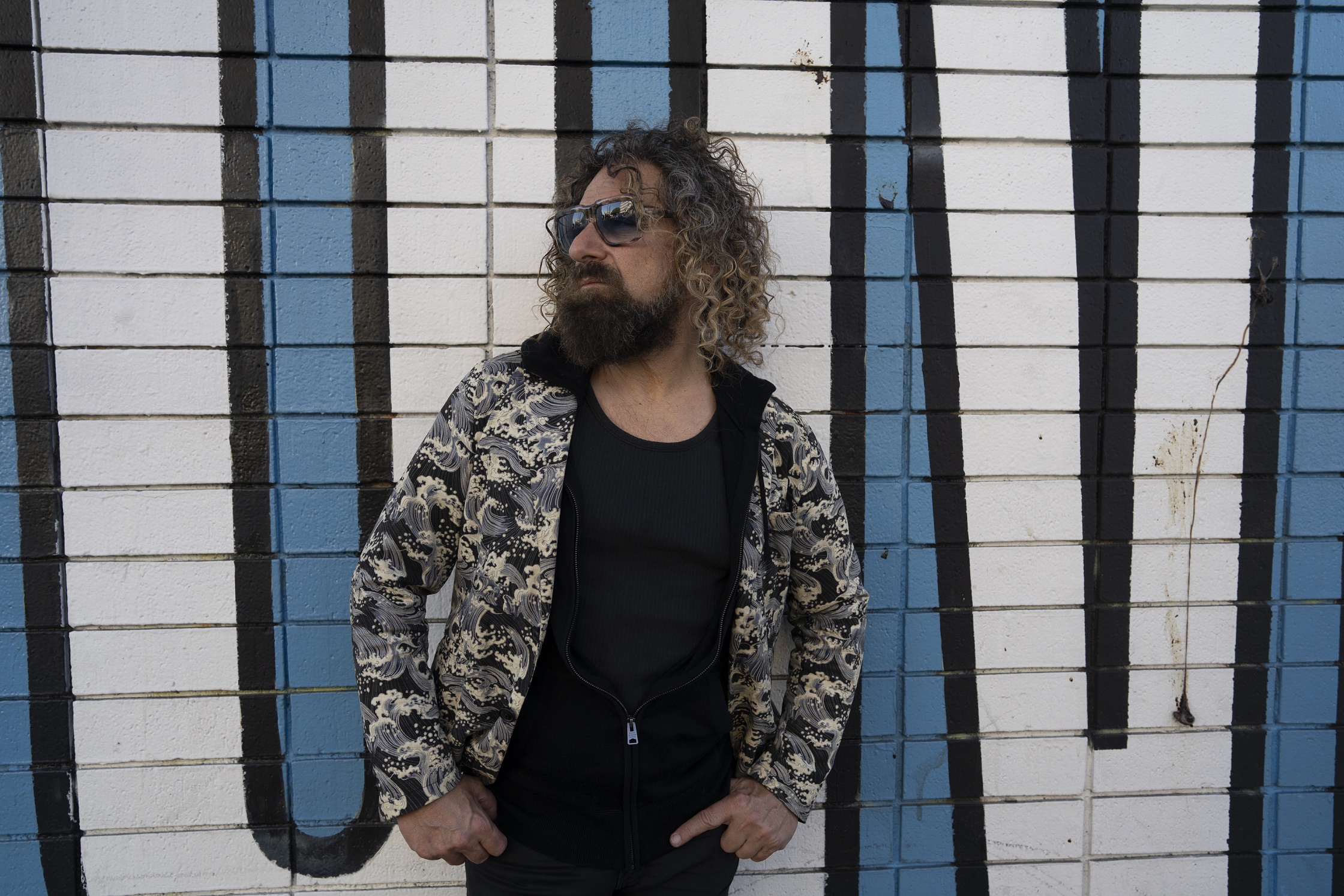
Max Vanderwolf lives in parallel worlds. As a restless musician, he refuses to stand still. As his birth name Glenn Max, he’s spent decades coaxing unforgettable performances out of legends like David Bowie, Patti Smith and Ornette Coleman. His new record, “Songs You’ll Never Hear” sits somewhere between dread and myth. Max caught up with us on a Zoom call from Los Angeles.
Hoping to glean some inspiring advice for rising musicians from someone with a rich and diverse career in the industry, we asked where he finds hope for the future. Instead, Vanderwolf awkwardly but flatly said: “I’m not an optimist.” Yet, this isn’t a case of a veteran throwing in the towel. Having witnessed decades of industry shifts, Vanderwolf isn’t cynical—he is clear-eyed. He understands exactly how grim the current landscape is, and his bluntness serves as an urgent wake-up call for serious action rather than passive optimism.
The Splice: Thank you so much for taking the time to speak with us. I find your discography incredibly genre-defying. Looking back at your background, who would you say is your biggest musical influence?
Vanderwolf: Like a lot of people, if I have to choose one, I automatically go to The Beatles. The sweep of their music, the freedom they had to create, and the production across all their records—whether orchestral or pure rock and roll—is deeply inspiring. I’m not interested in rewriting the same song; I’m always looking for new challenges, whether that’s writing a deceptively simple song or something complex with rich arrangements and complicated time signatures, and they are the blueprint for me.
Beyond the Beatles, my earliest influences are Creedence Clearwater Revival, Pink Floyd, David Bowie, punk rock like Bad Brains, Dead Kennedys and Public Image Ltd. Then, a fair amount of jazz and experimental stuff like Tortoise. Right now I’m digging the new Boards of Canada record. I think it’s about keeping yourself interested in a broad range of music and keeping yourself interested in trying new things.
However, while influences guide you to a degree, you also need to break free of them. I often get compared to David Bowie. On this new record, I tried so hard to avoid that influence, and I thought I was successful. But people still hear it anyway! Next time, I think I’m just not going to care so much.
The Splice: You also have a fascinating parallel career under your birth name, programming major festivals like the Meltdown Festival. Does your experience as a curator and promoter feed into your own music production?
Vanderwolf: My role as a concert promoter or producer working with these artists benefits from my perspective as a musician. I understand what an artist wants, why they need things a certain way, and what they prioritise. It allows me to be highly empathetic.
But as a musician, the business of producing concerts has nothing to do with the process of making music. When I’m writing, I just do my thing. My life as a promoter doesn’t really enter into it.
They are just entirely different practices. As a musician, you spend most of your time alone writing, preparing, and learning to play the material before you ever bring other people into the room. You are challenging yourself to write something worthwhile enough to justify the expense and the emotional trauma of bringing it to life.
Promoting, on the other hand, requires a massive team. And it’s the art of persuasion—convincing artists, managers, and agents that you have a great conceptual idea. I’ve been lucky to work at prestigious venues that gave me the clout to persuade artists to do unusual things. My speciality was building live projects that stood out from a standard concert.
The Splice: I want to ask about your new album, Songs You’ll Never Hear. This album is heavily driven by an orchestral sound, bringing a very atmospheric, spacey, and psychedelic mood. What was your motive in choosing this particular production style for this record?
Vanderwolf: Well, it came about very organically. I feel like this record sort of cements together quite nicely despite the different influences. It’s true that if I think about who some of the influences are, they don’t necessarily go together on paper. But for some reason, when I listen through the album, I feel like it’s a cohesive whole.
The orchestral elements for this album were dictated by the songwriting. It wasn’t that I sat down and said, “Oh, I’m going to make an orchestral album.” It was just that the parts I was writing called for horns. It had to be horns. There was no question, and I didn’t limit myself at all. As far as I was concerned, this was probably going to be my last record ever. So, I didn’t really care about the commerciality of what I was writing; I was writing for me. I think most artists get their best writing that way, when they’re writing for themselves.
The Splice: What did that recording process look like?
Vanderwolf: My friend and producer, Tim, and I spent a few weeks developing the songs. Next, we brought in a fantastic drummer, Charlie Paxson, which allowed us to really hear what we had. We spent about two weeks with Charlie, and then went into the studio and recorded 15 pieces of music in just two days. We redid them over and over, so they were two very long days of recording the basic tracks. Once we got in the studio, it went really fast because those guys are phenomenal musicians who learn material and put soul behind it quickly.
After those two days, we spent a long period overdubbing. We did it at Sunset Studios in Los Angeles, X-Star Studios, and in Tim’s home studio in East Hollywood. A lot of magic was, in fact, made in that home studio. We were working in such tandem that it felt like we were writing together through osmosis.
It was, though it took longer than I would have liked. That overdubbing process took at least a year. There were a lot of breaks, but in some ways, that was a very healthy way to go about it. It gave us time to adjust. Writing lyrics and developing vocal ideas also takes forever for me, so having that time allowed me to change a lot of vocal ideas from what I originally intended. That said, I am eager for the next record to be a swifter process!
The Splice: Several tracks like ‘Be My Saviour’ tackle political issues like capitalism and corporate greed. Were you conscious of making this into a political album?
Vanderwolf: If you’re motivated by the emotional impact of what you’re experiencing on a daily basis, it was inevitable that some of these songs were going to have a political angle. I’ve never been averse to writing about current events, but I definitely try to personalise it. In other words, I don’t want to just write the news.
Now, I wouldn’t say that “Be My Savior,” the song you just mentioned, is purely political. It is on one level, but it’s really just a cry for help. It’s an attempt to find hope when you look around and can’t find it. This feeling can relate to a lot of personal situations in one’s life, not necessarily just the political landscape.
And I tried to elevate it to a more mythic level here. I reached out to the mythology of comic books, great poets, and aviator heroes, who are historical examples of hope that might help us get through and make me believe again. This song is about reaching out to the last vestiges of hope. This is a terrible, terrible time these days, and there’s another story just makes you want to turn your stomach every day.
The Splice: How do you view the current state of the music industry?
Vanderwolf: I’m going to tell you: I’m not an optimist (laughs). I think these are very bad times for music, particularly for music listening. The entire discovery process has become really corrupted by social media platforms. The industry is basing so many decisions on these algorithmic numbers, while at the same time, everyone admits this is not working. Yet, we keep going back to the numbers.
I can’t tell you how many industry people I’ve spoken to want to talk about Spotify and Instagram numbers. But we all know that those things can be manipulated, and I mean, they change the rules every month because they know this.
Then, you want to build your career by interacting with your fans live, but it’s very expensive to play live now. It used to be a much more vibrant live scene here in Los Angeles. Now there are still a few clubs going, but not like they used to be. I don’t see a change happening right now, but we need a change, and we need less dominance of the algorithmic culture that is all over the place.
The Splice: What do you ultimately want your audience to take away from this album?
Vanderwolf: Well, you know, I approach every album like it’s my last one. I don’t have the kind of self-sustaining economic foundation to just keep going indefinitely. So I always look at a project like, “This is it,” and I think for that reason, I get a lot of very dramatic points in my records.
Takeaway from this album… I guess I want the audience to genuinely involve themselves in the drama of what’s happening right now in this world. I’d like them to relate to the stories that are in these tracks. All of them capture a struggle, whether it’s an epic struggle or a comical one. Each song has a distinct narrative, and I would love for people to really get into the core meaning of them.
And you know, ultimately, I’d like them to come back and keep listening, because it’s really hard to be a musician these days. Any support that I can gather from music fans means the world to me.
Songs You’ll Never Hear is out now via Another Record Label
Photo: John Travis
Leave a Reply