
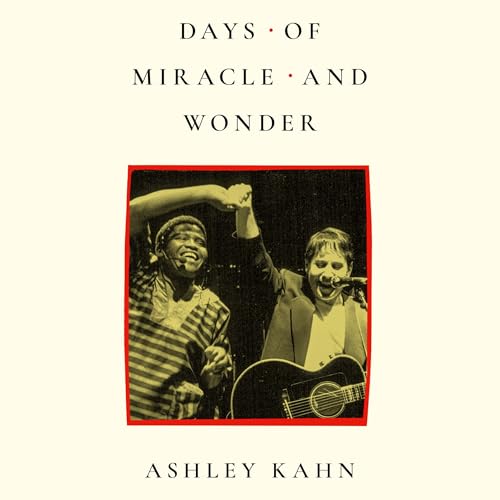

Paul Simon is one of those rare artists who was vital as a solo artist, and part of a larger group. Where contemporaries Paul McCartney, Mick Jagger and Bob Dylan had hit a plateau by the mid 1980’s, Simon landed on a golden goose; one that pointed a way for a new juncture in his career. “Graceland was born from this era of home taping, ” Ashley Kahn writes. “The piece of
music that served as its seed came from a collection released by the Go Go label, a subsidiary of Gallo Records, South Africa’s leading record company.”
Kahn’s latest book Days of Miracle and Wonder is as miraculous and wonderful as the title suggests. He presents the main character as a fascinating artist rippled with doubts and malcontent. Writing the title track, Simon was reluctant to reference Elvis Presley as the record was supposed to pay tribute to South Africa; ultimately, the phrase never left him, so it was committed to tape. The work was fairly revolutionary, although it took the trendy presses some time to catch up with the process. In his research, Kahn notes that Graceland was stuck between McCartney’s Press to Play and Iggy Pop’s Blah-Blah-Blah, despite being heads-and-shoulders over both works. By the close of 1986, Graceland was hailed as a record that helped salvage a fairly poor year for pop.
The style of music known as Mbaqanga took over Simon, who needed to compose his latest work as a tribute to the form. As it happens , the genre was considered jejune in some quarters in South Africa. This didn’t bother the songwriter: “The Boyoyo Boys were fresh to me even though they were out of style in South Africa.”
Using African tempos and timbres to American words and sentiments, Simon created a music that was universal. Besides re-working old tapes, the guitarist was keen to create entirely new music with South African musicians. Keen to express the message further, Simon guested on the power ballad “We Are the World”, duetting with such luminaries as Kenny Rogers and Stevie Wonder. The central tenet of universalism above all else in life was one the listening public, the liberal political contingent and the vocalists on the recording could get behind. In his younger days, Simon had supported Eugene McCarthy, the Democrat who challenged President Johnson by protesting the Vietnam conflict. Riches had changed much of Simon’s lifestyle, but not his heart.
Graceland as an album contrasted the work of Queen – who were in trouble for playing to a segregated audience at Sun City – who were busy using samplers and synthesisers all over their “organic guitars”. Simon felt “bored with the top 40”, so turned to the “fringes” for inspiration, coming across Mbaqanga. Kahn writes eloquently about this transformation from hobby to muse to monster-successful record. Chevy Chase was invited to take a cameo in the video to “You Can Call Me Al”, mouthing the words to the tune while the diminutive Simon waded comedically across the room.
Graceland stands up as one of the most inventive rock albums of the decade, precisely because it was thought outside of the box. Besides Simon, arguably only Peter Gabriel sounded so fresh because his work steeped around the continents. In 1987, it deservedly won the Grammy for Album of the Year, although “Decade” would have been just as appropriate. Indeed, it is Simon’s finest work, and deserves to be documented as Kahn has just done in Days of Miracle and Wonder. It is 2026, so 1986 is more history than culture, but the music lives on. So will this book.
Days Of Miracle and Wonder is out now via Atria Books. Order it here
Leave a Reply