
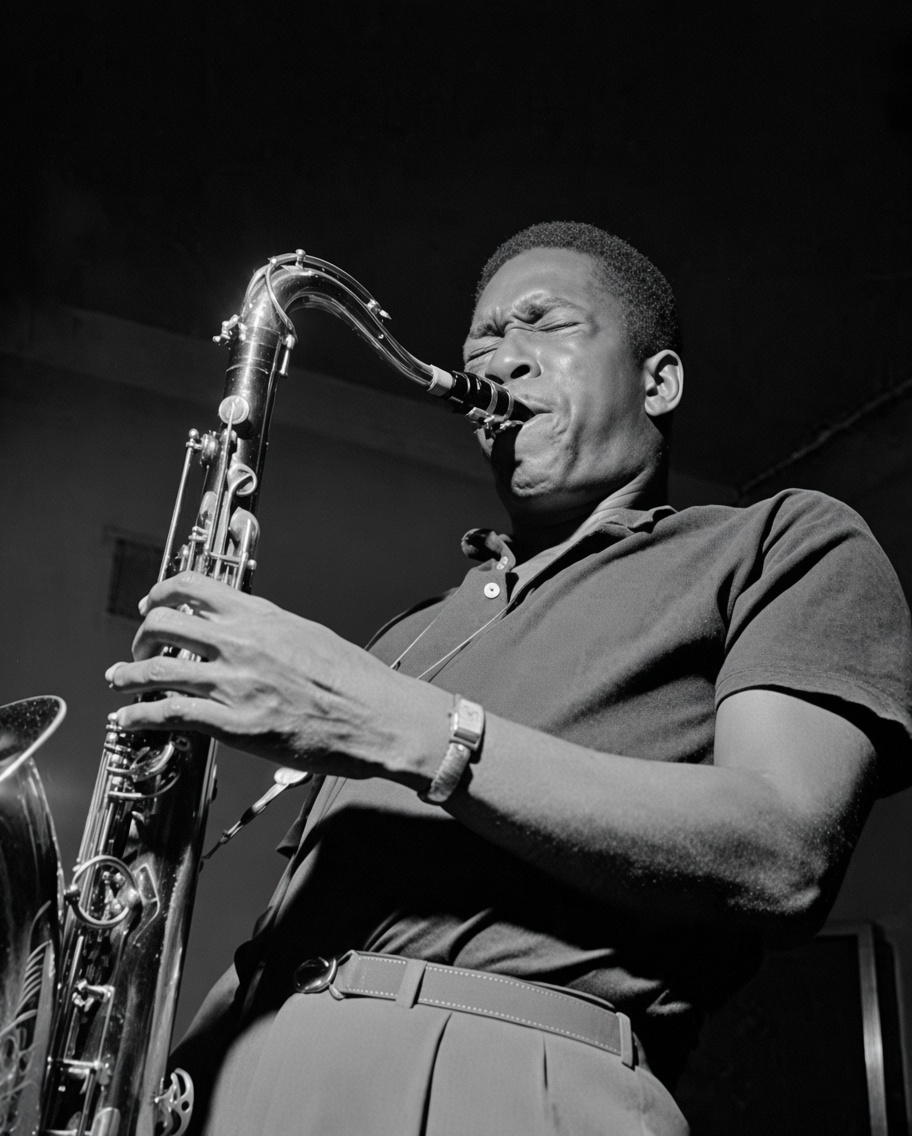
“Scores of people were gathering across from St. Peter’s Church to say goodbye. Hours passed. People were sobbing as the love cry of Albert Ayler spirited the atmosphere. It was as if a saint had died, one who had offered up healing music yet was not permitted to heal himself. Along with many strangers, I experienced a deep sense of loss for a man I had not known save through his music.”
Here, in the early chapters of her memoir, Patti Smith describes the Summer that John Coltrane passed away. The elegy demonstrates the way in which the death of Coltrane impacted all artists, of all disciplines. Even today, a hundred years after Coltrane was born, he is remembered as not only one of jazz’s greats, but as one of art’s greats, a creative inspiration to all. His talent and ability to bend boundaries marks the magnitude of his legacy.
Take Giant Steps, for example. The title track from his 1960 album became one of the most intellectually challenging jazz standards of its day, influencing an entire subgenre of fast and complex bebop. For those music-theory inclined, this comes from its rotation between three musical keys, all of which are equally as harmonically distant from each other as possible. However, for those who do not know music theory, its mathematical complexity can still be heard, as the track seems to refuse to settle in one harmonic place for long. It’s a historic masterpiece, a wonder to fans and academics alike.
Coltrane studied music in Philadelphia, moving from North Carolina in the 1940s. At only 23-years old, he joined Dizzy Gillespie’s ensemble. Having been prior obsessed with Charlie Parker as a student, he quickly found his own voice in Gillespie’s band, serving as a formative experience for the Coltrane that is instantly recognisable today.
In 1955, he joined Miles Davis’ band, another harmonic aficionado. Coltrane said of Davis, “There isn’t much harmonic ground he hasn’t broken.” Coltrane felt stimulated in Davis’ band to further explore harmony. However it was during this period that Coltrane fell into heavy drug and alcohol abuse, a common struggle for jazz musicians at this time. Falling into conflict with Davis and his band, Coltrane was let go. The second major rejection of his career, one could expect Coltrane to give up, to hang up his saxophone and call it a day. Instead, tenacious as ever, Coltrane took this as a sign to get his life in order.
By this point, another jazz veteran, Thelonious Monk, had heard of Coltrane, crossing paths with him many times in the New York and Philadelphia gig circuit. A testament to his resilience, Coltrane had fully recovered from his struggles with addiction, and in 1957, was invited to join Monk’s band.
They rehearsed in Greenwich Village, and due to Monk’s spirited discipline and challenging composition style, Coltrane grew both artistically, and mentally. “Working with Monk,” Coltrane once said, “brought me close to a musical architect of the highest order”.
And “architect” is certainly the perfect word for it, as Coltrane would go on to construct incredible albums perfectly balancing complexity, beauty, and testimony, to his perseverance as an artist.
He went on to record tracks with Monk which would later be released under the name Thelonious Monk with John Coltrane: The Complete April and July Riverside Recordings. Record producer Orrin Keepnews would call it “one of the most memorable collaborations in the history of jazz”.
Coltrane’s legacy is steeped in jazz heritage, collecting anecdotes with some of jazz’s figureheads, while also constructing an individual discography underpinned by resilient talent. His most popular album, A Love Supreme, would be released in 1965, two years before his death. The album’s improvisational and spiritual attitude represents a struggle for purity, within the harmonic beauty. By 1970, it had sold 500,000 copies, far more than ten times Coltrane’s usual sales prior to this point, marking him as one of jazz’s most influential saxophonists.
John Coltrane’s career is defined by historic collaborations and a constant urge to improve. Due to his early rejections, he was ruthlessly critical of his own work. His tenacity is admirable to artists of any discipline, and his music is adored by all. Even now, a hundred years on, his records have stood the test of time; there are seldom conversations about jazz in which Coltrane is left out. Why would there be?
Photo: Francis Wolff
Leave a Reply